
What Is Risk Appetite? How to Turn a Board Statement into Limits People Actually Use
What is risk appetite? Learn how it differs from capacity and tolerance, what a good statement contains, and how to cascade it into limits and KRIs.
9 min read
The board approves a risk appetite statement once a year. It says the bank has a "low appetite for operational risk" and "no appetite for compliance breaches". Three weeks later, a team leader has to decide whether to approve a policy exception that lets a payment go out without a second check. Is that within appetite? Nobody can say, because the statement never says what "low" means in practice.
That is the most common problem with risk appetite. The statement exists, but it never reaches the people making daily decisions. It sits in a board pack instead of guiding approvals, limits and KRIs.
This article explains what risk appetite is, how it relates to risk capacity, tolerance and limits, and how to turn a board statement into concrete limits that people can actually use.
What is risk appetite?
Risk appetite is the amount and type of risk an organisation is willing to take to achieve its objectives. The Financial Stability Board (FSB), the international body that monitors the global financial system and makes recommendations to the G20, set the common terms most financial institutions now use. It defines risk appetite as the aggregate level and types of risk a firm is willing to assume within its risk capacity to achieve its strategy and business plan.
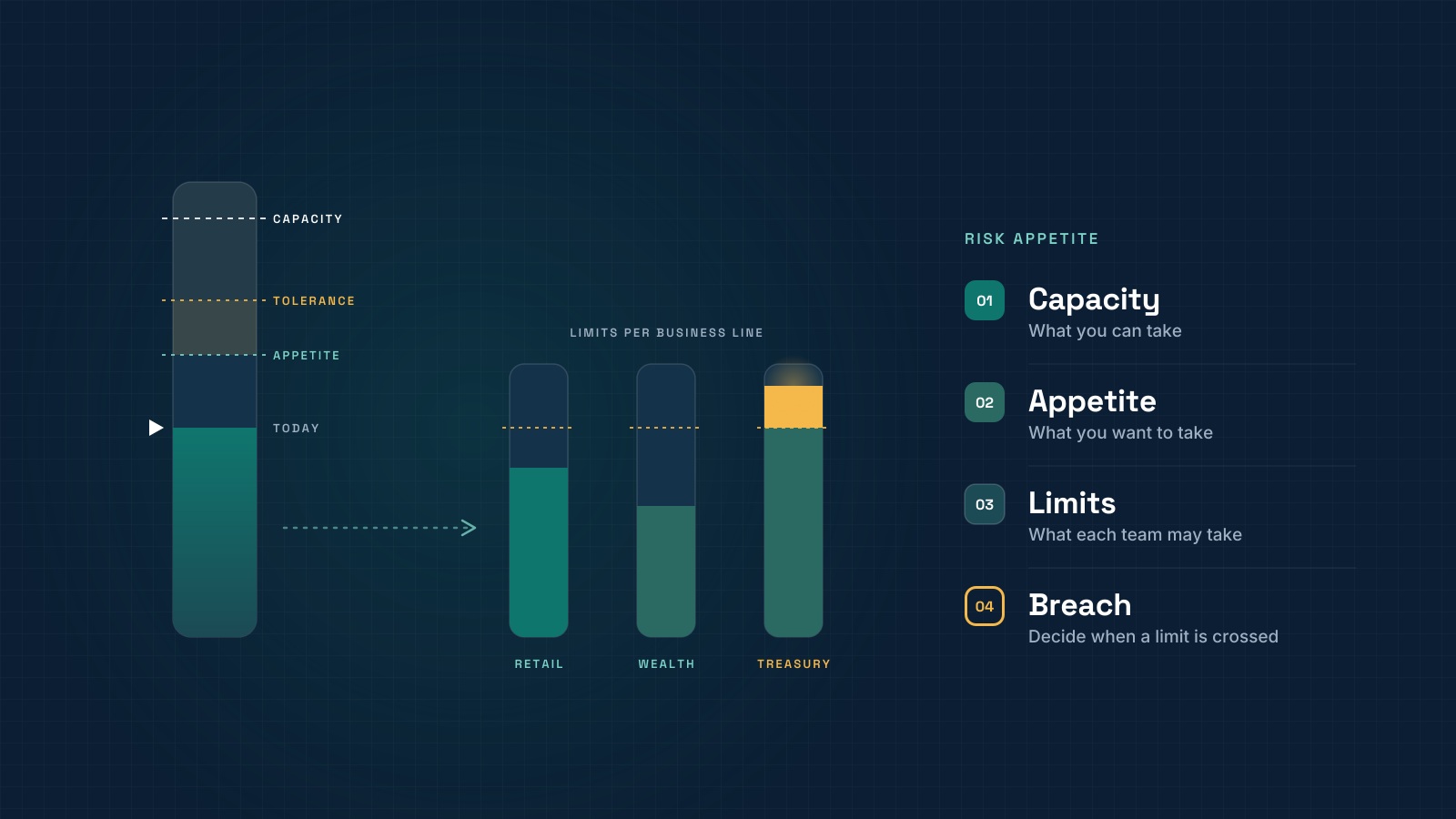
Four related terms are often mixed up. They fit together like this:
- Risk capacity: the maximum risk the organisation can take before breaching regulatory capital or liquidity requirements, or its obligations to clients and other stakeholders.
- Risk appetite: the risk it wants to take, set below capacity to leave a buffer.
- Risk limits and tolerances: concrete measures that turn appetite into thresholds for individual risks, business lines or activities.
- Risk profile: the risk the organisation actually has today, measured against appetite and limits.
Example: A bank's regulators require a capital ratio of at least 11%. That defines its capacity. The board sets an appetite to stay above 14% in normal times and above 12.5% in a severe stress scenario. Limits for each business line are set so that, added together, they keep the bank above 14%. Today the ratio is 15.2%, which is the risk profile: inside appetite, with room to grow.
Why does risk appetite matter so much?
Risk appetite is the reference point that most other risk management tools depend on:
- Decisions: it tells you whether the worst case of an option is acceptable. See how risk management affects business decision-making.
- KRIs: it sets the amber and red thresholds. See how to build key risk indicators.
- Residual risk: it decides whether what remains after mitigation can be accepted. See risk management vs risk mitigation.
- Strategy: it shows which risks are worth taking to reach strategic goals. See risk assessments and business strategy.
- Reporting: it gives the board a clear line to report against. See communicating risks to stakeholders.
Without a usable appetite, each of these becomes a matter of opinion.
What does a good risk appetite statement contain?
A good statement is short enough for the board to own and specific enough for managers to use. In practice, it covers:
- A link to strategy: which risks the organisation takes deliberately to reach its goals, and which it avoids.
- Quantitative measures: numbers for the risks that can be measured, such as capital, liquidity, losses, downtime or concentration.
- Qualitative statements: clear positions on risks that are hard to measure, such as conduct, reputation, money laundering and ethics.
- Forward-looking checks: scenarios that show what could push the organisation outside its appetite.
- Clear roles: who sets, monitors and escalates.
The Financial Stability Board's principles cover all of these, including that quantitative measures should translate into limits for business lines and legal entities, and that the statement should also address risks that are hard to put a number on.
How do you turn the statement into limits people can use?
The key step is the cascade: from a board statement, to measurable metrics, to limits for each business line, to KRIs that people monitor every day. Here is how a Swiss private bank could do it for three parts of its statement.
Example: The board statement reads: "We accept a moderate level of operational risk to support our digital growth. We have no appetite for losing client data. We rely on third parties, but only where we keep them under control." The bank translates it like this:
- "Moderate operational risk": annual operational losses within CHF 2 million (appetite), escalation to the board at CHF 3 million (tolerance). The CHF 2 million is split across business lines, for example CHF 0.8 million for retail operations and CHF 0.5 million for asset management.
- "Support digital growth": unplanned downtime of online banking below 120 minutes per month, with amber at 60 minutes.
- "No appetite for losing client data": no confirmed client data breach and every laptop encrypted. Critical vulnerabilities on internet-facing systems, or any with a known exploit, are patched within 48 hours; all other critical patches within 14 days. Any breach goes to the executive committee the same day.
- "Third parties under control": no critical vendor without a security assessment in the last 12 months, and no more than 30% of critical services with a single provider.
Each metric now has an owner, a threshold and a KRI. When the team leader from the introduction considers that payment exception, the question becomes concrete: does it increase the risk of fraud losses beyond the retail operations limit, or weaken a control the bank relies on to stay within appetite?
What does "zero appetite" really mean?
Many statements say "no appetite" or "zero tolerance" for certain risks, such as compliance breaches or data loss. That is a legitimate position, but it needs to be understood correctly.
- It is about behaviour, not outcomes: no risk can be reduced to zero. Zero appetite means the organisation will not knowingly accept the risk, will invest in strong controls, and will act immediately when something happens.
- It needs measurable signals: since the target is zero, the useful indicators are the ones that move first, such as control failures, near misses and overdue actions.
- It needs a clear response: every event triggers escalation and a root-cause review, not just a note in the next quarterly report.
When used everywhere, "zero" loses meaning. Keep it for the few risks where the organisation genuinely accepts no deliberate exposure.
Who is responsible for what?
- Board: approves the risk appetite statement, reviews it at least once a year, and decides on major breaches.
- Senior management: translates the statement into limits, allocates them across business lines, and makes sure they are respected.
- Business lines: take risk within their limits, monitor their KRIs, and escalate breaches.
- Risk function: independently monitors the risk profile against appetite, challenges the business, and reports breaches.
- Internal audit: checks whether the framework works as designed and whether limits are actually followed.
What happens when a limit is breached?
A breach is not a failure of the framework. It is the framework doing its job. What matters is the response, which should be agreed in advance:
- Escalate: the owner informs the right level within an agreed time, for example 24 hours for a tolerance breach.
- Analyse: what caused it, and is it a one-off or a trend?
- Decide: bring the risk back within the limit, accept a temporary breach with a clear end date, or propose a change to the appetite itself.
- Record: document the decision and who made it.
Example: Operational losses in retail operations reach CHF 0.9 million by September, above the CHF 0.8 million limit. Analysis shows one large fraud case caused most of it. Management tightens the payee-change control, the board is informed, and the business line's limit stays unchanged. If losses had been rising across many small cases, the right response might have been a broader review of controls, or an honest discussion about whether the appetite still fits the strategy.
How do the pieces fit together?
Risk capacity sets the outer boundary. Appetite sets the target zone inside it. Limits and tolerances bring appetite down to business lines and activities, and KRIs show daily where the risk profile is moving. Breaches trigger decisions, and the annual review adjusts appetite as strategy and conditions change.
When this works, risk appetite stops being a board document and becomes the common language for decisions across the organisation. For how appetite fits into the wider identify, assess, treat and monitor cycle, see what is risk management.
Where do teams get stuck?
- Vague words: "low", "moderate" and "high" without numbers or clear definitions.
- No cascade: the statement exists at board level but never becomes limits or KRIs.
- Appetite equals capacity: no buffer, so the first bad quarter pushes the organisation close to regulatory limits.
- Too many metrics: 80 appetite measures that nobody can monitor. Start with the 10 to 15 that matter most.
- Never revisited: an appetite set before a major strategy change no longer fits the business.
- Breaches without decisions: limits are exceeded, reported and then ignored.
How do you measure whether it's working?
- Cascade coverage: share of appetite statements translated into at least one measurable limit.
- KRI linkage: share of KRIs whose thresholds come directly from an appetite limit.
- Breach response: average time from breach to documented decision.
- Repeat breaches: number of limits breached more than twice in a year.
- Decision use: share of major decisions that explicitly checked risk appetite.
- Annual review: whether the board reviewed and approved the appetite in the last 12 months.
What do frameworks and regulators expect?
The Financial Stability Board's Principles for an Effective Risk Appetite Framework set the common definitions and expectations for financial institutions: a risk appetite statement linked to strategy, risk limits, and clear roles for the board and senior management. The Basel Committee's corporate governance principles use a closely matching definition of risk appetite.
In the euro area, the ECB's 2024 draft guide on governance and risk culture described a well-developed risk appetite framework as a cornerstone of good governance. In Switzerland, FINMA Circular 2023/1 requires the board to approve the tolerance for operational risks at least once a year. Outside finance, COSO's enterprise risk management framework includes defining risk appetite as one of its principles.
Where does Risk Navigator fit?
Risk appetite only works when limits are connected to the data that shows whether they are respected: losses, KRIs, control results, vendor assessments and exceptions. In many organisations, that data is scattered, so nobody can see the risk profile against appetite until the quarterly report.
Risk Navigator adds a layer on top of your existing tools that links appetite limits to the KRIs, risks and controls behind them, so you can see where you stand against appetite at any time, and which breaches need a decision.
In short
- Appetite sits below risk capacity: it is the risk you want to take, with a buffer to what you can take.
- Make it measurable: turn words like "low" and "moderate" into numbers and clear positions.
- Cascade it: from board statement to business-line limits to daily KRIs.
- Agree the breach response: escalate, analyse, decide and record.
- Review it every year: appetite has to follow strategy, not the other way round.
Where can you read the source texts?
- Definitions of risk capacity, appetite and limits: FSB, Principles for an Effective Risk Appetite Framework (2013).
- Full text of the FSB principles: FSB principles (PDF).
- Risk appetite in bank governance: Basel Committee, Corporate governance principles for banks (2015).
- Reporting breaches of appetite: BIS executive summary of the operational risk principles.
- ECB view on risk appetite frameworks: Overview of the ECB's draft guide on governance and risk culture.
- FINMA operational risk tolerance: FINMA Circular 2023/1 "Operational risks and resilience – banks".
- Risk appetite in enterprise risk management: COSO, Enterprise Risk Management – Integrating with Strategy and Performance, Executive Summary (2017).
Want to see your risk profile against appetite at any time, not just once a quarter? Talk to us about adding Risk Navigator on top of the tools you already use.