Risk Management vs Risk Mitigation: What’s the Difference?
Risk management is the whole system; risk mitigation is one response inside it. Learn how they differ, with examples, KPIs and what DORA and FINMA expect.
8 min read
Ask five people in your organisation what "risk mitigation" means and you'll probably hear five versions of "risk management". The two terms get used as synonyms in board packs, audit findings and vendor brochures. They aren't the same thing, and mixing them up has a cost.
Teams that treat mitigation as the whole job end up with long lists of controls and no clear view of which risks actually matter. Teams that talk about "risk management" but never mitigate end up with a beautiful register and nothing changing.
This article explains the difference in plain terms, shows how the two fit together, and gives you the KPIs to tell whether each one is working.
The short answer
Risk management is the system. Risk mitigation is one move inside it.
Risk management is the full, ongoing discipline: you set objectives and risk appetite, identify and assess risks, decide how to respond, monitor the results and report to the people who make decisions. NIST describes it as the process of identifying risk, assessing it and taking steps to bring it down to an acceptable level.
Risk mitigation is narrower. The NIST glossary defines it as prioritising, evaluating and implementing the right risk-reducing controls coming out of the risk management process. It explicitly calls mitigation a subset of risk response.
In other words, risk management decides which risks to act on and how far. Mitigation is the work of actually reducing them.
What does risk management cover?
Risk management answers the strategic questions: What are we trying to achieve? What could stop us? How much uncertainty are we willing to carry? Who owns each risk? The international standard ISO 31000:2018 frames risk as the effect of uncertainty on objectives, which means upside as well as downside. Mitigation only ever deals with the downside.
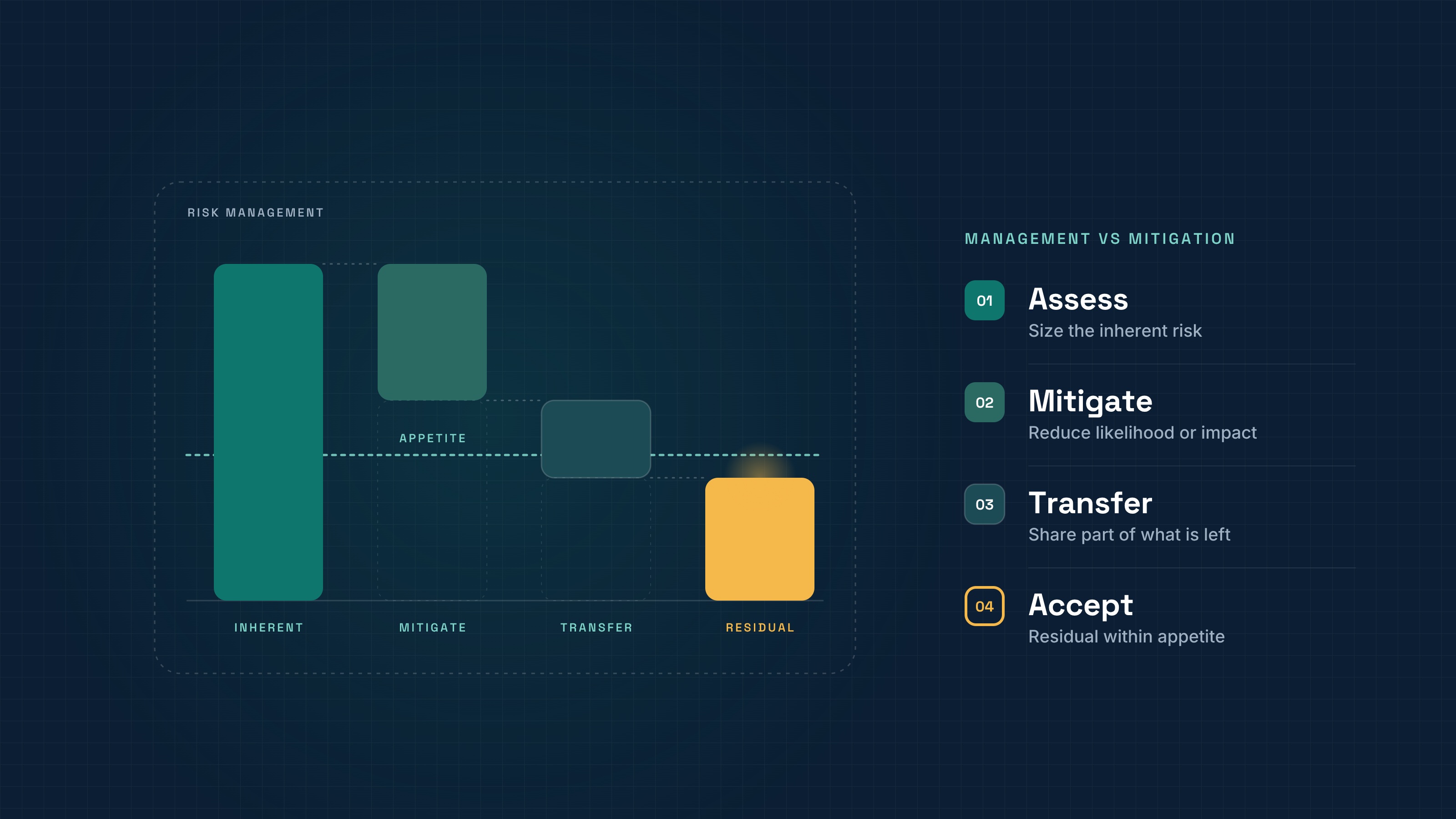
Example: An online retailer with €80 million in revenue sets a clear appetite: the order platform may not be down for more than 24 hours, and no single incident may cost more than €1.5 million. Its risk assessment flags ransomware as likelihood 3 and impact 5, a score of 15 out of 25 and well outside appetite. That decision, "this risk is too big and must come down", is risk management. Nothing has been mitigated yet.
- Sets direction: objectives, appetite, priorities and owners.
- Chooses the response: mitigate, avoid, transfer or accept.
- Closes the loop: monitors residual risk and reports it to decision-makers.
For a full walkthrough of the cycle, see What Is Risk Management? An Introduction.
What does risk mitigation actually involve?
Mitigation means putting controls in place that lower a risk's likelihood, its impact, or both. Controls come in three broad types:
- Preventive: stop the event happening (multi-factor authentication, segregation of duties, supplier vetting).
- Detective: spot it early (monitoring, reconciliations, alerting).
- Corrective: limit the damage once it happens (backups, incident playbooks, alternative suppliers).
Example: The retailer rolls out MFA for all admin accounts and endpoint detection on every server, which brings likelihood down from 3 to 2. It also adds immutable offline backups with a tested 12-hour restore, which brings impact down from 5 to 3. The residual score falls from 15 to 6: inside appetite.
Mitigation pays off when it's done well. IBM's Cost of a Data Breach Report 2025 found that organisations using AI and automation extensively in security operations saved an average of $1.9 million per breach and cut the breach lifecycle by 80 days.
- Target the driver: decide whether you are attacking likelihood or impact, and pick controls that actually move it.
- Test before you trust: a backup nobody has restored is an assumption, not a control.
- Cost it: a control that costs €400,000 a year to cut expected loss by €100,000 is a bad deal.
Mitigation is one of several responses
ISO 31000 lists a broader set of risk treatment options. Mitigation covers only the ones that change likelihood or consequences. The others are:
- Avoid: stop the activity that creates the risk.
- Take or increase the risk: deliberately accept more risk to pursue an opportunity.
- Remove the source: eliminate the hazard while keeping the activity.
- Change the likelihood or consequences: this is mitigation.
- Share or transfer: contracts, outsourcing and insurance.
- Retain: accept the risk by informed decision.
Choosing among these is a risk management decision, and mitigation isn't always the answer. Sometimes it's cheaper to avoid an activity or to insure it. But transfer is often thinner than it looks. After the July 2024 CrowdStrike outage, Parametrix estimated that cyber insurance would cover only 10–20% of the Fortune 500's $5.4 billion in direct losses.
Example: On top of its controls, the retailer buys €3 million of cyber cover with a €250,000 retention. It formally accepts the remaining exposure. Mitigation did most of the work, transfer took a slice, and risk management documented the acceptance.
How the two fit together
Think of risk management as the frame and mitigation as one of the tools inside it. The frame tells you which risks to work on, how far to bring them down and when to stop. The tool does the reducing. Without the frame, mitigation turns into a shopping list. Without the tool, risk management becomes a reporting exercise.
Two real cases show the difference.
When mitigation rested on untested assumptions: In the 2017 NotPetya attack, Maersk had to reinstall about 4,000 servers, 45,000 PCs and 2,500 applications in ten days. The total cost was $250–300 million. Maersk's CISO later said both the primary and backup Active Directory systems were taken out, a scenario the company had never thought possible. The controls existed. Risk management had never stress-tested whether they would hold against that scenario.
When risk management drove better mitigation: After the 2011 earthquake, Toyota needed weeks to work out which suppliers were hit. It then built a supplier risk database. When a strong earthquake struck Niigata in 2019, the Japan Times reported that Toyota confirmed within half a day that its supply chain was unaffected. A risk management lesson led to a concrete mitigation.
Where teams get stuck
- Controls without risks. A list of 300 controls with no link to the risks they reduce. Nobody can say which ones matter or which could be dropped.
- Mitigating everything. Every risk gets a control, regardless of appetite. Budget goes to low-impact risks while the big ones sit untreated.
- Never measuring residual risk. Controls get implemented, but nobody rescores the risk afterwards. You can't tell whether the money worked.
- Treating insurance as mitigation. Transfer moves money after the fact. It doesn't stop your platform going down.
- One-off projects. Mitigation is delivered, the project closes, and the control quietly decays. Only an ongoing risk management loop catches that.
How do you measure each one?
Because they do different jobs, they need different KPIs.
Risk management KPIs tell you whether the system works:
- Coverage: share of critical processes with assessed risks.
- Ownership: share of top risks with a named owner and an agreed response.
- Within appetite: share of top risks whose residual score sits inside appetite.
- Surprises: material incidents that were not in the register.
Risk mitigation KPIs tell you whether the controls work:
- Control test pass rate: share of key controls tested in the last 12 months that passed.
- Risk reduction: the drop from inherent to residual score per risk, and the cost per point of reduction.
- Action delivery: overdue mitigation actions as a share of all open actions.
- Recovery performance: actual versus target restore time in tests and real incidents.
What regulators expect
Supervisors ask for both: a governed management framework and controls that demonstrably work.
- DORA (EU): the Digital Operational Resilience Act has applied since 17 January 2025. It requires a documented ICT risk management framework (the system) plus protection, detection, response and recovery measures, along with resilience testing (the mitigation).
- FINMA (Switzerland): Circular 2023/1 has been in force since 1 January 2024. It sets expectations for managing operational risks across the institution, with specific requirements for ICT, cyber and critical data risks, and for operational resilience.
- SOX (US): management must assess internal control over financial reporting. That means mapping financial reporting risks to the controls that mitigate them, and testing those controls.
The common thread: regulators want to trace a line from each significant risk to the controls that reduce it, and see evidence that those controls work.
Where Risk Navigator fits
Risk Navigator sits as an extra layer on top of the tools you already use. It links each risk to its objectives, its appetite, the controls that mitigate it and the evidence that those controls work. You can see inherent and residual risk side by side, spot controls that no longer map to a real risk, and catch residual risk drifting back outside appetite.
In other words: risk management and mitigation in one connected picture, instead of a register in one place and a control list in another.
In short
- Risk management is the system: objectives, appetite, assessment, response choice, monitoring and reporting.
- Risk mitigation is one response inside it: controls that reduce likelihood or impact.
- Mitigation isn't always the right choice; avoid, transfer and accept are valid options when they cost less.
- Always rescore after mitigating, so you know whether residual risk is inside appetite.
- Measure both: system KPIs (coverage, ownership, surprises) and control KPIs (test pass rate, risk reduction, recovery times).
Sources
- NIST CSRC, Glossary: risk mitigation
- NIST, Risk Management Guide for Information Technology Systems (SP 800-30)
- ISO, ISO 31000:2018 Risk management – Guidelines
- Engineers Australia, Risk treatment (ISO 31000 options)
- IBM, Cost of a Data Breach Report 2025 (July 2025)
- Parametrix, CrowdStrike to cost Fortune 500 $5.4 billion (July 2024)
- The Register, IT 'heroes' saved Maersk from NotPetya with ten-day reinstallation blitz (January 2018)
- Dark Reading, Maersk CISO says NotPetya devastated several unnamed US firms
- The Japan Times, Toyota looks to develop ways to disaster-proof its supply chains (July 2019)
- ESMA, Digital Operational Resilience Act (DORA)
- FINMA, Circular 2023/1 Operational risks and resilience – banks