
What Is Risk Management? Definition, Process & Examples
Most risk registers get updated once a year and ignored. Here’s how to run risk management as a weekly loop: identify, assess, treat and monitor.
8 min read
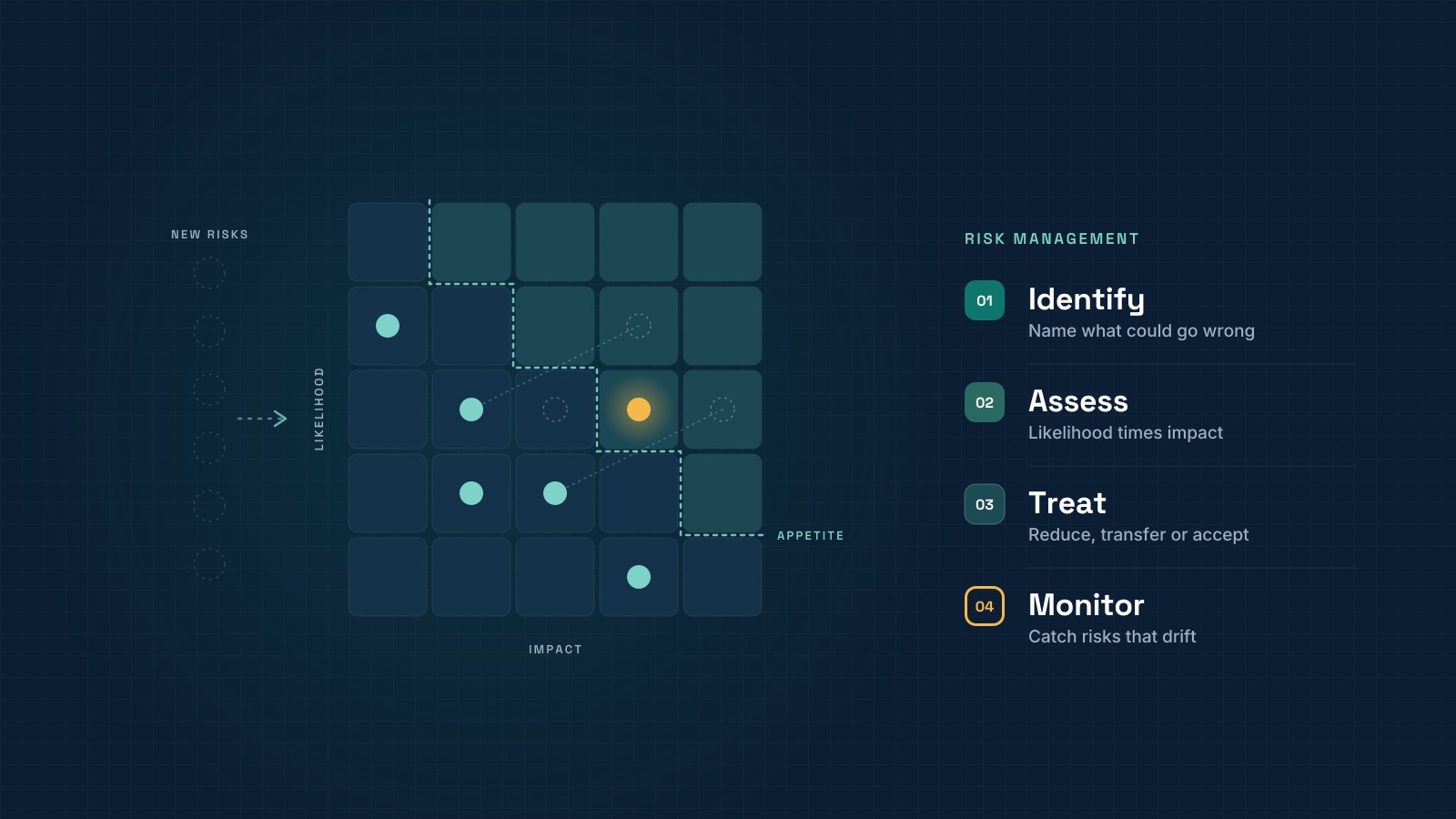
Every organisation already manages risk. The question is whether it does so on purpose. A finance team that insists on two signatures above €10,000 is managing risk. So is an IT lead who keeps a second cloud region warm, or a buyer who refuses to source a critical part from a single supplier.
The trouble starts when those decisions live in people's heads, spreadsheets and habits instead of a shared picture. Then nobody can say which risks matter most, who owns them, or whether yesterday's controls still work today.
This introduction walks through what risk management actually is, the four steps that make it work, where teams usually get stuck, and how to tell whether your approach is paying off.
What is risk management, really?
The international standard ISO 31000:2018 defines risk as the "effect of uncertainty on objectives". That small shift matters. Risk isn't only "bad things happening". It's any deviation from what you planned, in either direction. ISO says the 2018 revision made creating and protecting value the main reason to do risk management at all.
The other widely used framework, COSO's Enterprise Risk Management: Integrating with Strategy and Performance, was revised in 2017 to tie risk directly to strategy-setting. It is organised around five components: governance and culture, strategy and objective-setting, performance, review and revision, and information, communication and reporting.
So risk management is the discipline of making decisions with your eyes open. You find what could knock you off course, decide how much of it you are willing to carry, and act on the rest. Most organisations group their risks into a handful of families:
- Strategic: a competitor, a technology shift or a bad bet that undermines your plan.
- Operational: failed processes, people, systems or third parties, including cyber incidents and outages.
- Financial: credit, liquidity, currency and market movements.
- Compliance: breaching laws, regulations or contracts.
- Reputational: loss of trust, which usually follows one of the four above.
The mix is shifting. In the Allianz Risk Barometer 2026, cyber incidents topped the list for the fifth year running with 42% of responses. Artificial intelligence jumped from #10 to #2.
Step 1: How do you identify risks?
Identification means writing down what could stop you reaching a specific objective. A generic list won't do; tie each risk to a goal, a process or an asset. "Cyber risk" is a topic. "Ransomware encrypts the payroll system three days before month-end" is a risk you can act on.
Example: A 300-person distributor runs a one-hour workshop per department, asking one question: "What would stop you delivering next quarter?" Logistics names a single carrier handling 70% of shipments. Finance names one person who knows the payment-run process. Neither had ever appeared in the board's risk report.
- Start from objectives, not from a template of risk categories.
- Write risks as cause → event → consequence, so owners know what they are actually controlling.
- Look outside: suppliers, cloud providers and regulators are a growing source of risk you don't control directly.
Step 2: How do you assess and prioritise risks?
Once risks are named, you estimate two things: how likely they are and how badly they would hurt. A simple 5×5 matrix (likelihood 1–5, impact 1–5) is enough to start, as long as everyone uses the same scale with concrete definitions.
Example: The distributor defines impact 5 as "more than €2 million loss or a week of lost deliveries" and likelihood 4 as "likely within two years". The single-carrier risk scores 4 × 5 = 20. The key-person risk in finance scores 3 × 3 = 9. The carrier gets attention first.
Put real numbers behind the scales wherever you can. IBM's Cost of a Data Breach Report 2025 puts the global average breach at $4.44 million and the US average at a record $10.22 million. Benchmarks like these keep impact scores honest.
- Define every score in money, time or customers, not adjectives like "high".
- Score the risk before and after controls (inherent vs residual), so you can see what your controls are worth.
- Revisit scores after incidents, including near misses elsewhere in your industry.
Step 3: What can you do about a risk?
Every risk ends up with one of four responses:
- Avoid: stop the activity that creates the risk.
- Reduce: add controls that lower likelihood or impact.
- Transfer: shift the financial impact to someone else, usually through insurance or contracts.
- Accept: consciously carry the risk because it sits inside your risk appetite.
Transfer is often weaker than teams assume. After the July 2024 CrowdStrike outage, Parametrix estimated $5.4 billion in direct losses for Fortune 500 companies. It also estimated that cyber insurance would cover only about 10–20% of that, because of large retentions and low policy limits.
Example: The distributor reduces its carrier risk by signing a second carrier for 25% of volume. It transfers part of the remaining exposure with business-interruption cover and accepts the rest. The residual score drops from 20 to 8, and the board signs off on the remaining exposure explicitly.
- Name one owner per response, with a due date.
- Check insurance terms against your realistic scenario, not the policy headline.
- Document acceptance decisions: "we chose to carry this" is very different from "nobody noticed".
Step 4: How do you keep risks under watch?
Risks drift. A supplier's finances weaken, a control quietly stops running, or a new regulation changes the stakes. Monitoring means watching a few key risk indicators (KRIs), each with a threshold that triggers action.
Example: The distributor tracks "share of shipments with the main carrier" monthly, with an alert at 60%. When a busy season pushes it to 68%, the alert reaches the logistics head before it becomes a board surprise.
- Choose leading indicators (backlog of unpatched systems, supplier concentration), not just lagging ones (losses).
- Set thresholds with an owner and a playbook, so an alert produces a decision, not a discussion.
- Test controls, don't just assume them. A control nobody has tested is a hope.
How the pieces fit together
The four steps form a loop, not a project. ISO 31000 puts particular weight on the process being iterative: you refine it as new experience and analysis come in. New objectives create new risks, incidents change your scores, and treatments create new dependencies.
Two things hold the loop together. The first is risk appetite: a clear statement of how much risk the organisation will take, which tells owners when to act and when to accept. The second is communication: risk information has to reach the people who make decisions, in a form they can use, at the moment they need it.
Where teams get stuck
- The register becomes a compliance artefact. It gets updated once a year for the audit and ignored in between.
- Risks are scored in isolation. A cyber incident is also an operational, legal and reputational event. Allianz notes that only 3% of its 2026 respondents rate their supply chains as very resilient.
- Compliance risk is treated as paperwork. Volkswagen's emissions scandal shows the scale when it isn't. VW once estimated the overall impact at €27.4 billion, according to Bloomberg via Fortune, and a group spokesperson has since put total costs at around €33 billion.
- Nobody owns the risk. "IT" or "Finance" is a department, not an owner.
- Too many risks. A register with 400 entries tells the board nothing. Twenty well-described top risks tell it a lot.
How do you know it's working?
Measure the process, not just the outcomes:
- Coverage: share of key objectives and critical processes with assessed risks (target: 100% of critical processes).
- Ownership: share of top risks with a named owner and an agreed response.
- Timeliness: average days from a KRI breach to a documented decision.
- Control health: share of key controls tested in the last 12 months, and the share that passed.
- Treatment progress: overdue actions as a percentage of all open actions.
- Surprises: number of material incidents that were not in the register. This number should fall over time.
What regulators expect
For regulated firms, risk management is no longer optional good practice.
- DORA (EU): the Digital Operational Resilience Act has applied since 17 January 2025 to more than 20 types of financial entities. It requires a documented ICT risk management framework, incident reporting, resilience testing and oversight of ICT third parties.
- FINMA (Switzerland): Circular 2023/1 "Operational risks and resilience – banks" came into force on 1 January 2024. It has specific expectations for ICT, cyber and critical data risks, and gives up to two years' transition for operational resilience.
- SOX (US): listed companies must assess and report on their internal control over financial reporting, which in practice means a risk-based view of financial processes.
The common thread: supervisors want to see that you know your critical processes, the risks to them and the controls that hold them in place, and that management actually uses that information.
Where Risk Navigator fits
Most teams already have tools: a GRC system, ticketing, spreadsheets, a CMDB. Risk Navigator works as an extra layer on top of them. It connects risks to the objectives, processes and controls they affect, keeps owners and KRIs in one place, and shows when something drifts outside appetite.
The aim is not another register. It is a shared, current picture that turns the four-step loop into something your team runs every week, not once a year.
In short
- Risk is the effect of uncertainty on your objectives, and that includes upside as well as downside.
- The loop is identify → assess → treat → monitor, held together by risk appetite and good communication.
- Score in money and time, not adjectives, and score both before and after controls.
- Insurance transfers less than you think; plan for what you will actually carry.
- Measure the process: ownership, timeliness, control health and surprises.
- Regulators like DORA and FINMA now expect this to be documented and used, not just written down.
Sources
- ISO, ISO 31000:2018 Risk management – Guidelines
- ISO, The new ISO 31000 keeps risk management simple (2018)
- COSO, Enterprise Risk Management – Integrating with Strategy and Performance, Executive Summary (2017)
- NC State ERM Initiative, COSO's ERM Framework
- Allianz Commercial, Allianz Risk Barometer 2026 (January 2026)
- Allianz Commercial, Global risk #3: Business interruption (January 2026)
- IBM, Cost of a Data Breach Report 2025 (July 2025)
- Parametrix, CrowdStrike to cost Fortune 500 $5.4 billion (July 2024)
- Fortune / Bloomberg, VW fights investors as diesel-scandal cost could top $35 billion (September 2018)
- Yahoo News, Dieselgate: Volkswagen's emissions scandal troubles are far from over
- ESMA, Digital Operational Resilience Act (DORA)
- FINMA, Circular 2023/1 Operational risks and resilience – banks